
Sizing the Wet Well for Giant-Flow Submersible Pump Stations

Most performance complaints on 300mm-and-up submersible stations turn out to have nothing wrong with the pump. The motor runs at rated current, the seal is fine, and the flow still comes in under the curve. The usual culprit is the pit around it.
Submergence is the first thing to check. Every submersible pump has a minimum water depth above the suction bell below which it starts pulling air, and that depth grows with flow rate: a 2000 m³/h unit needs meaningfully more cover than a 200 m³/h one, not because the pump is different but because the vortex that forms at low submergence scales with velocity. Pumps that “surge” or vibrate intermittently at partial fill are very often just running below that threshold, especially late in a pump-down cycle when the float switch hasn’t cut out yet.
Approach velocity matters just as much and gets ignored more often. Water arriving at the pit inlet fast and at an angle sets up a rotating flow pattern that a straight suction bell can’t fully correct. This is where vortex suppression fins, a baffle wall, or simply relocating the inlet pipe earns its cost back the first time it prevents an unplanned shutdown. On stations running two or more giant-flow units in a shared pit, this stops being optional: the pumps interfere with each other’s flow field long before either one hits its own rated limit, and no amount of individual pump selection fixes a pit that was never modeled for simultaneous operation.
Floor clearance and bay separation are the quieter details. Sediment that would just wash past a small pump’s inlet tends to settle and pack against the base of a giant-flow unit, because the local velocity right at the floor is lower relative to the flow moving overhead. A sloped floor toward the suction bell, with enough separation between adjacent pump bays that one unit’s suction cone doesn’t overlap another’s, keeps that problem from compounding over the years rather than the first season.
None of this shows up on a pump curve. It shows up in commissioning reports as “flow below spec, cause unclear,” usually right around the point where a hydraulic engineer gets called in after the concrete is already poured, rather than before.
Products in This Series
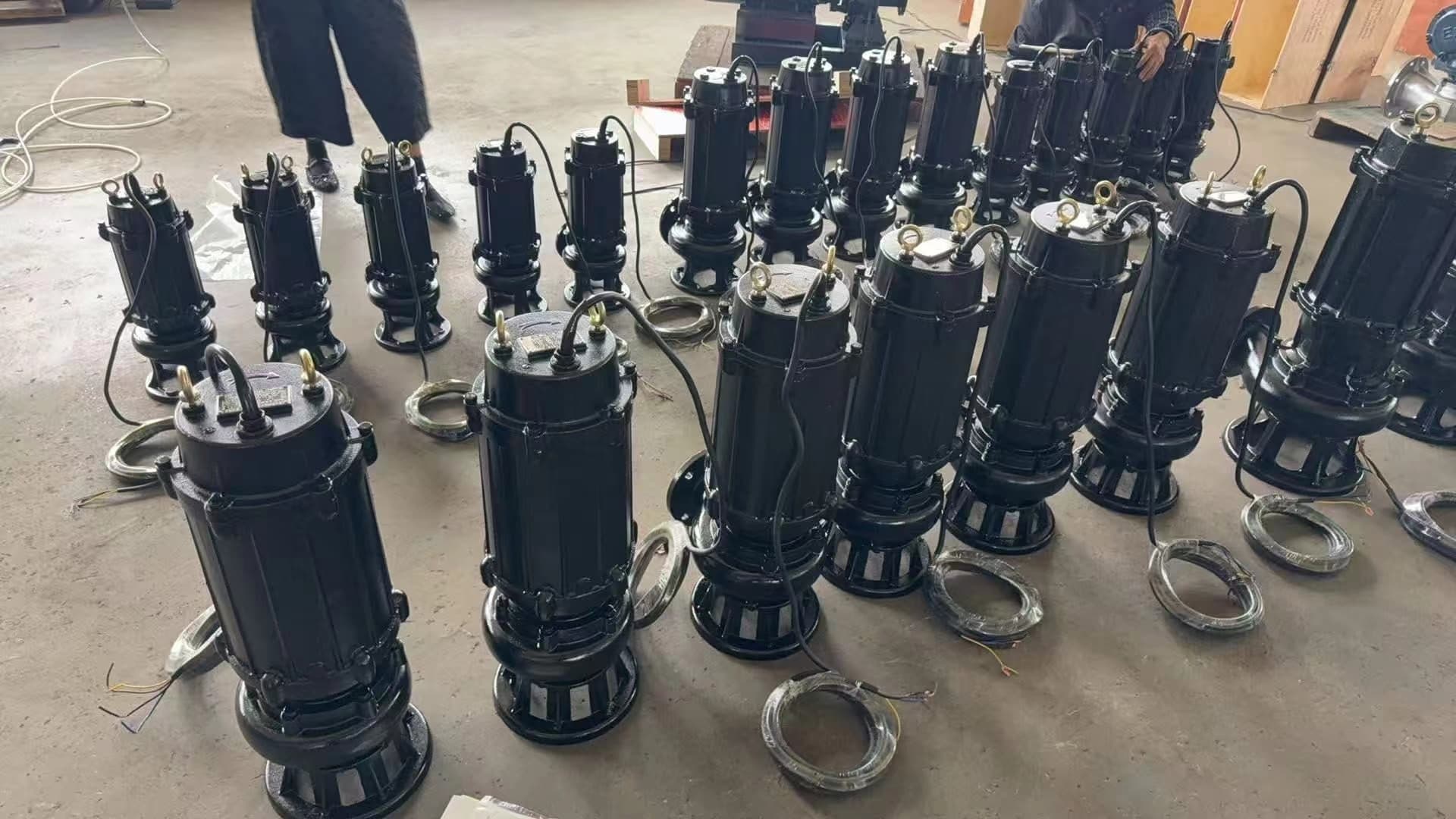 Submersible Sewage Pumps
200QW250-18-22 Sewage Pump: Factory Test Results
200QW250-18-22 submersible sewage pump: 250 m³/h at 18 m, 22 kW, DN200. Factory test results: 19.19 m at 250 m³/h and 68.6% pump efficiency.
Submersible Sewage Pumps200QW300-15-22 Submersible Sewage Pump, 300 m³/h 15 m
200QW300-15-22 submersible sewage pump: 300 m³/h at 15 m, 22 kW 4-pole, DN200 outlet. Installation dimensions, flange data and drawing download.
Submersible Sewage Pumps150QW180-15-15 Sewage Pump: Curve and Dimensions
150QW180-15-15 submersible sewage pump: 180 m³/h at 15 m, 15 kW 4-pole, 1450 r/min, DN150. Performance curve explained and installation dimensions.
Need a pump for your application?
Our engineers respond to technical inquiries within 24 hours.
Get a Quote