
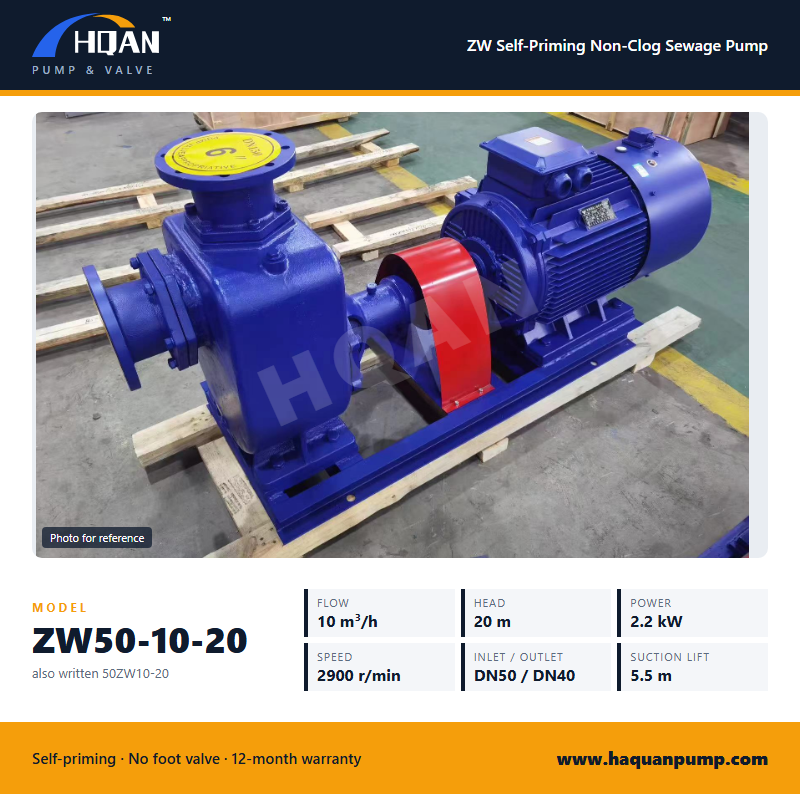
ZW50-10-20 Self-Priming Sewage Pump, DN50 Suction
ZW50-10-20: 10 m³/h at 20 m, 2.2 kW, DN50/DN40. Same duty as ZW32-10-20 and ZW40-10-20; when the bigger inlet is worth it.
10
Flow Rate (m³/h)
20
Head (m)
2.2
Power (kW)
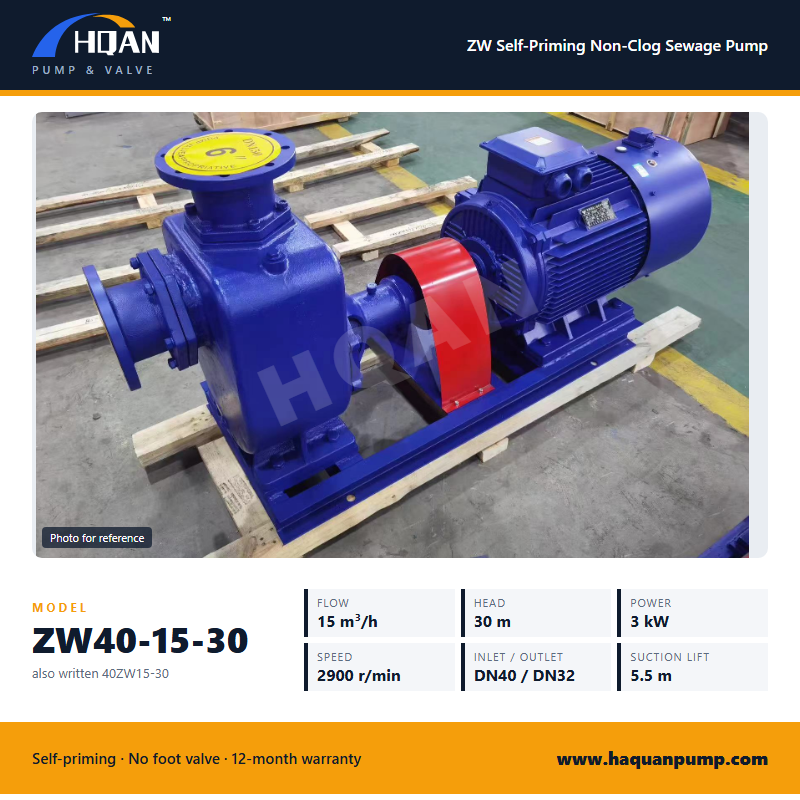
Model: ZW40-15-30
ZW40-15-30: 15 m³/h at 30 m, 3 kW, DN40/DN32. Six points to confirm before you order a ZW self-priming pump.
| Flow Rate | 15m³/h |
|---|---|
| Head | 30m |
| Power | 3kW |
| Inlet / Outlet Diameter | 40 / 32mm |
| Material | Cast iron (standard); stainless steel on request |
Not sure this pump fits your duty? Try the pump selector
ZW40-15-30 pumps 15 m³/h to 30 m on a 3 kW motor. Before you order it, or any ZW pump, run through these points with us.
Send us those six answers and we will confirm the model or suggest a better one.
| Item | ZW40-15-30 |
|---|---|
| Flow | 15 m³/h |
| Head | 30 m |
| Motor power | 3 kW |
| Speed | 2900 r/min |
| Efficiency | 48 % |
| NPSHr | 2.5 m |
| Self-priming height | 5.5 m |
| Self-priming time | 3 min per 5 m |
| Suction / discharge | DN40 / DN32 |
| Weight | 120 kg |
The pump, coupling and motor are mounted on a common base. L is the overall length; L1 to L4 are base lengths; a and f locate the outlet; B1 and B2 are the base widths; H is the shaft centre height; h1 and h2 are the heights of the suction and discharge flanges; h3 is the base thickness.
| L | L1 | L2 | L3 | L4 | a | f | B1 | B2 | H | h1 | h2 | h3 | Base bolts | |
|---|---|---|---|---|---|---|---|---|---|---|---|---|---|---|
| ZW40-15-30 | 890 | 710 | 130 | 450 | 240 | 260 | 510 | 310 | 370 | 238 | 410 | 630 | 24 | 4×Ø18 |
| Flange | DN | Outer dia. D | Bolt circle | Raised face | Thickness b | Face height f | Bolts n×d |
|---|---|---|---|---|---|---|---|
| Suction | 40 | 130 | 100 | 80 | 14 | 2 | 4×Ø14 |
| Discharge | 32 | 120 | 90 | 70 | 14 | 2 | 4×Ø14 |
ZW50-10-20: 10 m³/h at 20 m, 2.2 kW, DN50/DN40. Same duty as ZW32-10-20 and ZW40-10-20; when the bigger inlet is worth it.
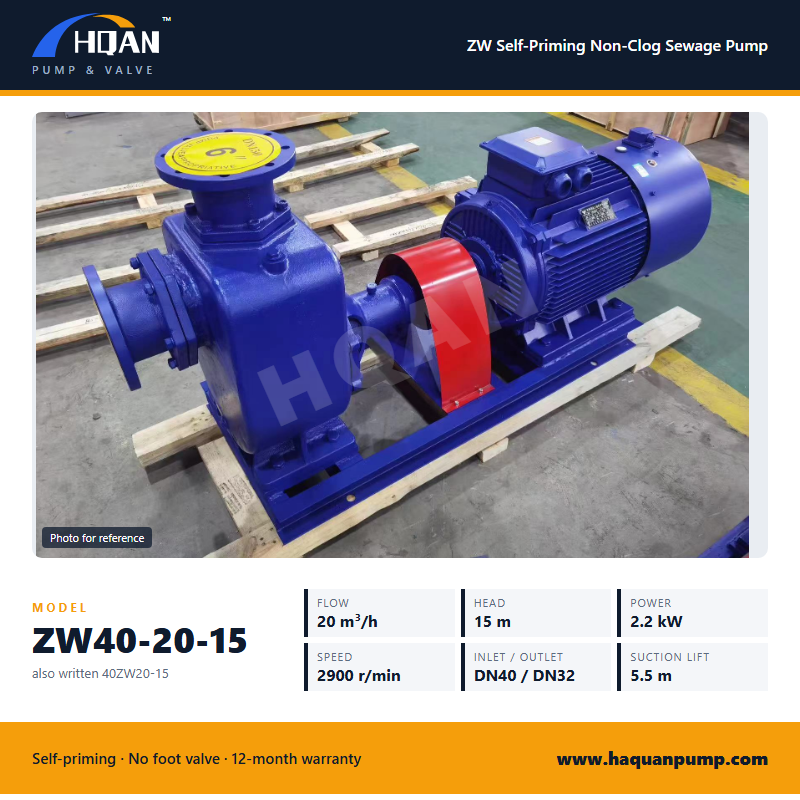
ZW40-20-15 moves 20 m³/h at 15 m on 2.2 kW. Step-by-step first start, from filling the casing to checking rotation.
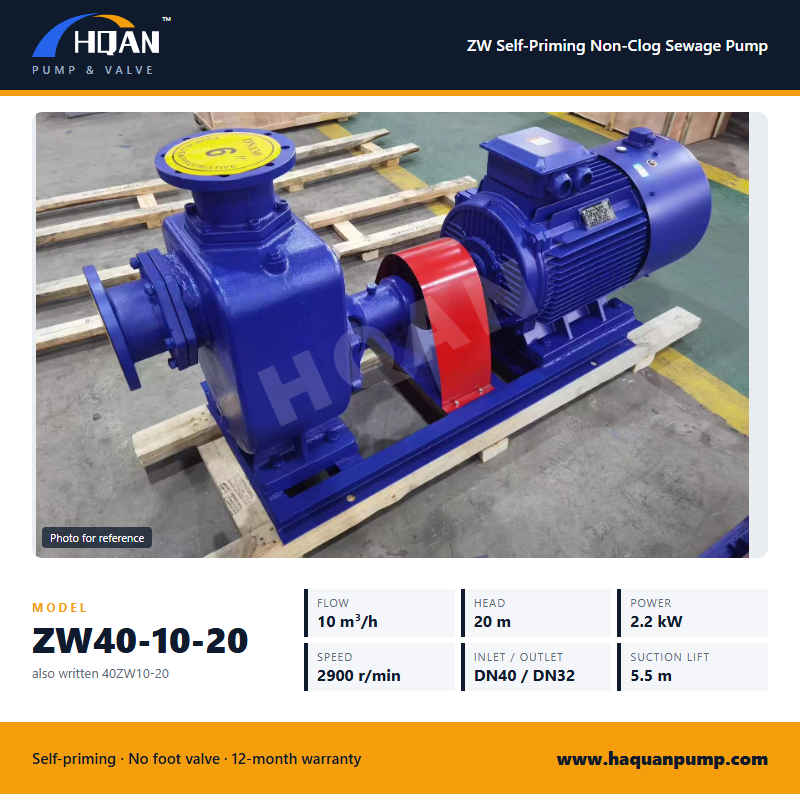
ZW40-10-20: 10 m³/h at 20 m, 2.2 kW. Why the suction is DN40 and the discharge DN32, and how to plan the pipework.