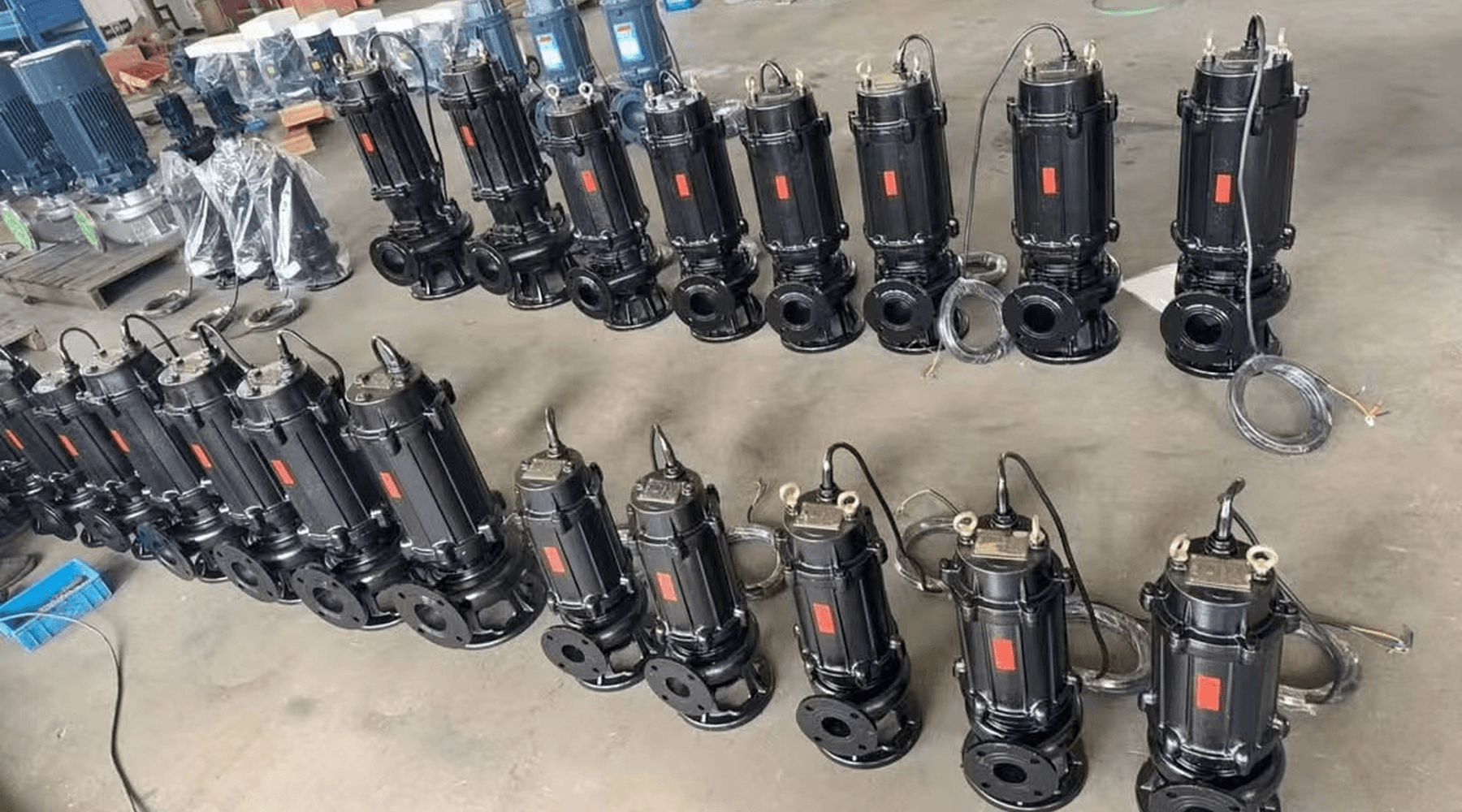
Buyers comparing submersible sewage pumps usually start with flow and head, and only ask about the impeller once something has already gone wrong. That’s a mistake, because the impeller passage is what decides whether a pump actually survives real sewage.
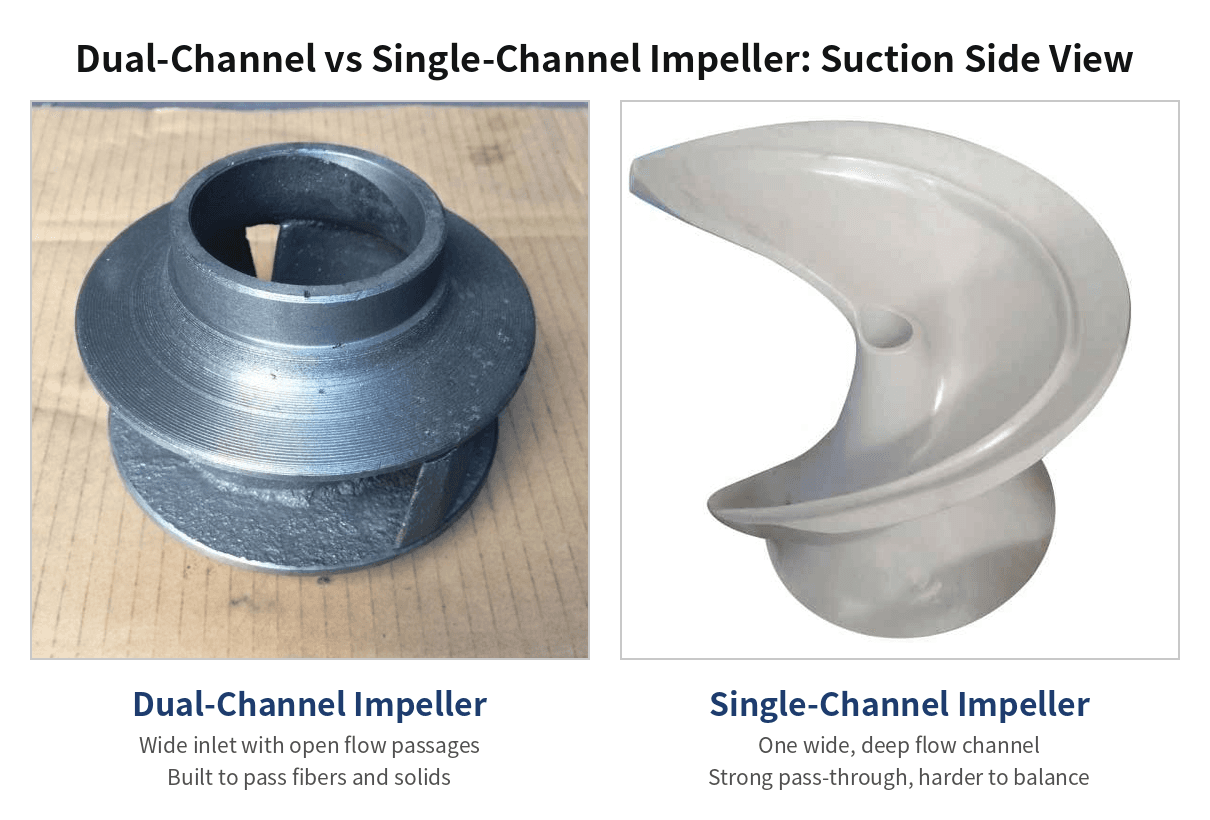
Dual-channel impeller (left) and single-channel impeller (right) used in submersible sewage pumps
What a Single-Channel Impeller Looks Like
A single-channel impeller has one wide, deep flow channel shaped like a spiral shell. That single open path gives it strong clog resistance for large debris, long fibers and coarse solids. The trade-off is balance: the shape is not symmetrical, so dynamic balancing is harder to get right, and the pump tends to run with more noise and vibration, especially after extended service.
What a Dual-Channel Impeller Looks Like
A dual-channel impeller uses two symmetrical wide channels instead of one. Because the design is balanced on both sides, dynamic balancing is easier to achieve, and the pump generally runs more smoothly with lower noise and vibration. It resists wrapping and clogging well, which makes it a common choice for sewage containing fibers, rags and general debris. Most WQ and GWQ series submersible sewage pumps on the market use this configuration.
The Efficiency Trade-Off
Single-channel designs concentrate flow into one path, which can give a small efficiency advantage. Dual-channel designs sacrifice a little of that efficiency for the sake of symmetry and balance, so efficiency is typically slightly lower. In practice the gap is small, and for most sewage duties it’s outweighed by lower vibration and fewer clogging-related shutdowns — an unplanned blockage costs far more than a percentage point of pump efficiency.
Which One Fits Your Application
If the wastewater regularly carries large solids, long fibers or woven material, a single-channel impeller’s raw pass-through capability may be worth the trade-off in vibration. For typical municipal sewage, residential wastewater and general industrial effluent with moderate fiber content, a dual-channel impeller is usually the easier pump to live with day to day. Either way, match the choice to the pump’s published performance curve and the actual solids profile of the application.


 Submersible Sewage Pumps