
Single-Channel vs Double-Channel Impellers in Submersible Sewage Pumps
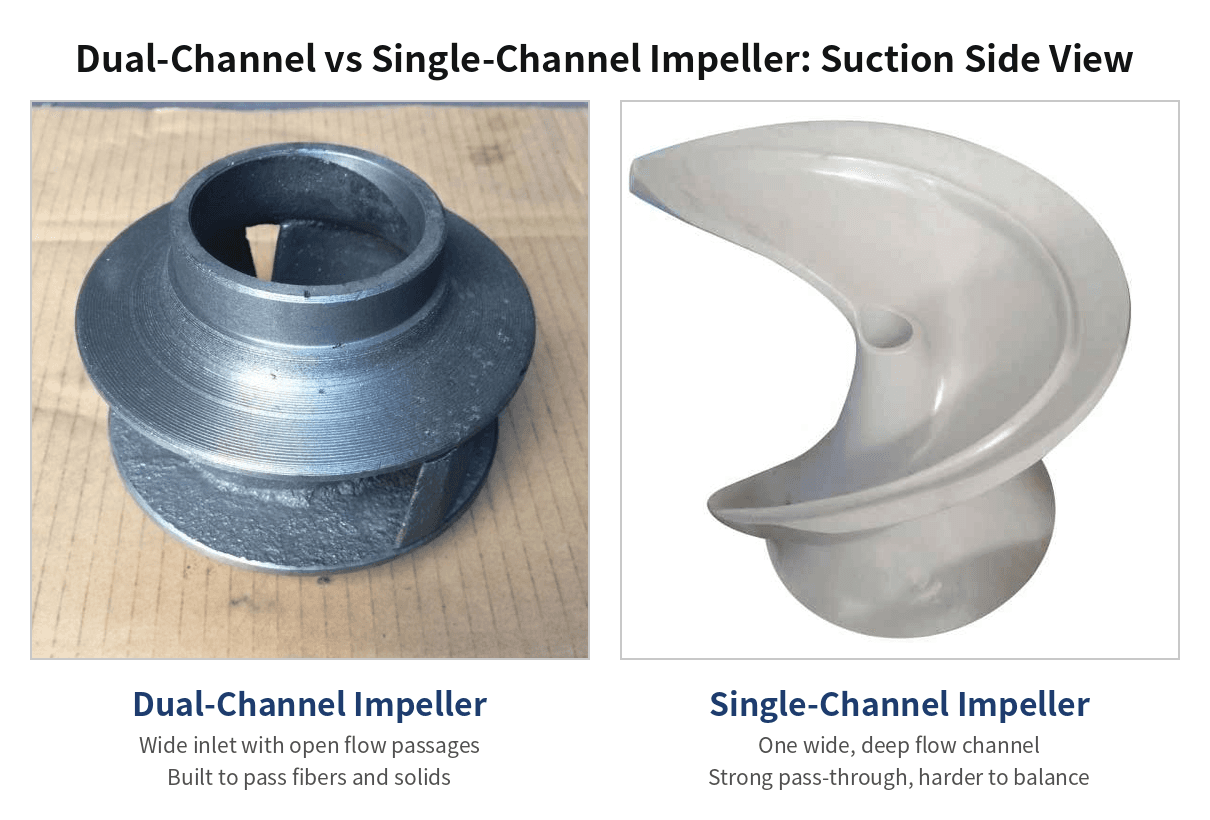
Single-Channel and Double-Channel Impellers: What Is the Difference?
The impeller is one of the most important components in a submersible sewage pump. Its design directly affects how the pump handles solids, fibers and wastewater, as well as its hydraulic efficiency and operating stability.
For non-clogging sewage pumps, two common configurations are the single-channel impeller and the double-channel impeller.
A single-channel impeller has one large curved hydraulic passage. A double-channel impeller has two passages arranged symmetrically around the shaft. Both designs are used in wastewater pumping, but they are suited to somewhat different operating conditions.
Single-Channel Impeller
The single-channel design provides a large, relatively open passage through the impeller. This makes it useful when wastewater contains long fibers or soft materials that can easily become trapped in a conventional multi-vane impeller.
Typical examples include wastewater containing:
- Plastic bags
- Textile fibers
- Hair
- Sanitary products
- Long fibrous materials
- Other soft solids
The large passage can reduce the possibility of winding and blockage. This is one reason single-channel impellers continue to be used for demanding sewage applications. Industrial pump manufacturers also offer single-channel non-clogging designs specifically for sewage and wastewater service.
Double-Channel Impeller
A double-channel impeller uses two hydraulic passages arranged in a balanced configuration.
The symmetrical design gives the rotating assembly better hydraulic balance. In practical applications, this can contribute to smoother operation and more stable running characteristics.
The technical material supplied for this pump design indicates a typical hydraulic efficiency range of approximately 55%–60% for the double-channel configuration, compared with approximately 50%–55% for the single-channel configuration. It also identifies better running balance as one of the key advantages of the double-channel design.
Commercial wastewater pump manufacturers likewise offer double-channel non-clogging impellers for municipal sewage, industrial wastewater and sewage lifting applications.
Which Impeller Should Be Used?
There is no universal answer because the correct impeller depends on the wastewater characteristics and pump duty.
A single-channel impeller can be considered when the wastewater contains a high proportion of long fibers or soft deformable materials and blockage resistance is the primary concern.
A double-channel impeller is often preferred when the wastewater contains a mixture of solids and fibers and the pump is expected to operate for long periods with good efficiency and stable performance.
The supplied technical comparison also identifies double-channel designs as a common choice for municipal and industrial applications because they provide a more balanced combination of solids handling, efficiency and operating stability.
Cast Iron or Stainless Steel?
The impeller material should also be selected according to the pumped liquid.
For general municipal sewage and wastewater, cast iron is widely used because of its strength, wear resistance and cost effectiveness.
For applications requiring improved corrosion resistance, 304 stainless steel can be considered. More demanding chemical environments may require other stainless-steel grades such as 316L, depending on the actual liquid composition.
Commercial sewage pump designs are available with cast iron as well as stainless-steel impellers.
Conclusion
The difference between a single-channel and double-channel sewage pump impeller is not simply the number of passages.
The single-channel design emphasizes a large open passage and strong resistance to blockage from long and flexible materials. The double-channel design provides a more symmetrical hydraulic structure and is commonly selected where stable operation, efficiency and balanced running are important.
For many municipal and industrial wastewater installations, double-channel impellers are a practical mainstream configuration, while single-channel impellers remain valuable for wastewater with particularly difficult fibrous materials.
Need a pump for your application?
Our engineers respond to technical inquiries within 24 hours.
Get a Quote