
How to Choose a Non-Clog, Corrosion-Resistant Pump
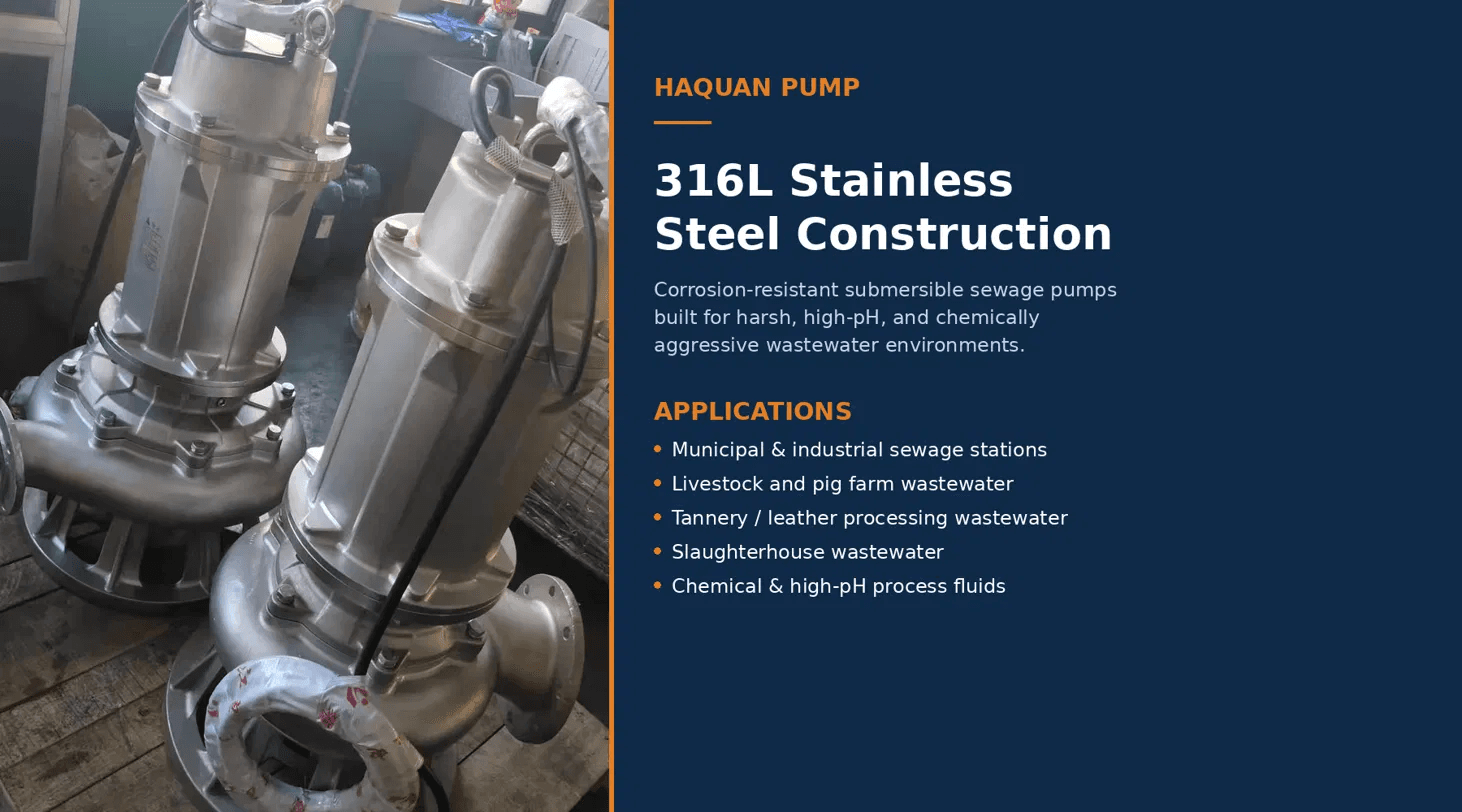
Why Non-Clog, Corrosion-Resistant Pumps Are the Fastest-Growing Segment in Wastewater — and How to Choose the Right One
If you’ve been shopping for a sewage or wastewater pump recently, you’ve probably noticed two words showing up everywhere: non-clog and corrosion-resistant. That’s not a coincidence — these two features have become the two biggest differentiators in the industry, and for good reason.
THE MARKET IS TELLING US SOMETHING
Non-clog sewage pumps are currently the fastest-growing segment of the submersible pump market, expanding significantly faster than the overall market average. Meanwhile, industry reports consistently point to corrosion-resistant materials as a top priority for manufacturers investing in R&D.
In other words: the two things buyers care about most right now are “will it clog” and “will it survive my fluid.” Let’s break down why — and how to think about both when selecting a pump.
PROBLEM #1: CLOGGING
Real-world sewage isn’t clean water. It carries plastic bags, rags, gloves, diapers, and woven sacks — the exact kind of debris that jams a standard impeller within days of installation. A pump that clogs doesn’t just stop working; it causes backups, emergency call-outs, and downtime that’s expensive to fix.
What actually solves this:
- A semi-open rotary cutter impeller that shreds solids before they can wedge in the pump body
- Cutter blades made from heat-treated alloy steel (3Cr13) for wear resistance
- Adjustable cutter clearance (typically 0.2–0.5 mm) — because even a good cutter loses effectiveness as it wears, and clearance needs periodic re-adjustment to keep cutting performance up
This is the core design behind our GNWQ series cutting pumps, purpose-built for exactly this failure mode.
PROBLEM #2: CORROSION
The second issue is less visible but just as costly. Many wastewater streams aren’t neutral — they’re strongly acidic or alkaline, and standard cast iron simply doesn’t survive long in that environment.
A recent example from our own customer inquiries: a tannery in Cyprus needed a pump to handle lime wash and lime fleshing waste at pH 12–13. That’s a strongly alkaline, fine-particle slurry that will:
- Wear down the impeller over time
- Cause scaling and blockages
- Corrode ordinary cast iron
For applications like this, we recommend the full pump — wetted parts and body — be built in 316L stainless steel. It’s a higher upfront cost, but it’s the difference between a pump that lasts and one that fails within months.
Other applications where this matters:
- Livestock and pig farm wastewater (high ammonia, organic acids)
- Chemical and process wastewater
- Slaughterhouse effluent
A DETAIL BUYERS OFTEN MISS: PERFORMANCE DROPS WITH CONCENTRATION
Even with the right material, one more thing catches buyers off guard: flow rate isn’t fixed. In high-concentration slurries (for example, lime milk above 10% concentration), viscosity increases, and actual flow rate typically drops 15–30% below the clean-water performance curve. If you’re sizing a system based on catalog numbers alone, you may end up under-pumped in real operating conditions. Always size for your actual fluid, not just water.
PRACTICAL CHECKLIST BEFORE YOU BUY
When evaluating a non-clog / corrosion-resistant pump for your application, ask:
- What’s actually in my wastewater? (fibrous material, plastic, sand, high-solids content?)
- What’s the pH and chemical composition? (standard cast iron vs. 316L stainless steel decision)
- What’s my real operating concentration? (don’t size off the clean-water curve alone)
- What are the wear parts, and do I have spares? (cutter disc, impeller, and mechanical seal will need replacement over the pump’s life — ordering spares upfront avoids downtime later)
- Can the cutter clearance be adjusted in the field? (a fixed-clearance cutter degrades in performance and can’t be restored)
FINAL THOUGHT
The pumps winning in today’s market aren’t the ones with the flashiest specs — they’re the ones engineered around the two things that actually cause failures in the field: clogging and corrosion. If your current pump struggles with either, it’s worth a second look at both the impeller design and the material spec, not just the horsepower.
Have a specific wastewater application you’d like advice on? Send us your fluid characteristics (pH, solids content, concentration) and flow/head requirements, and we’ll recommend the right configuration.
Email: sales@haquanpump.com
Website: www.haquanpump.com
WhatsApp: +86 150 0057 7161
Related: GNWQ Series Non-Clog Cutting Sewage Pump — Product Details
Need a pump for your application?
Our engineers respond to technical inquiries within 24 hours.
Get a Quote