
What Fails First on a 24/7 Giant-Flow Pump Station, and When

Ask five site managers what breaks first on a large submersible sewage pump and you’ll get five different seal-versus-bearing arguments, but the actual order, across enough continuous-run stations, is fairly consistent. It’s just spread across a longer timeline than most maintenance schedules assume.
In the first year, almost nothing fails on a properly commissioned unit. What does show up early is installation-related: a coupling base that wasn’t quite level, a cable gland tightened without the right torque, sediment left in the pit from construction settling somewhere it shouldn’t. These aren’t wear failures, they’re setup failures, and they’re the reason a thorough first-month inspection catches problems a five-year warranty never will.
Somewhere between year two and four, on units running near continuous duty, the mechanical seal starts becoming the maintenance conversation. It rarely fails suddenly. The oil-chamber leak sensor is supposed to catch the slow version, water intruding into the oil cavity well before it reaches the motor windings, which is exactly why that sensor being wired into a monitored cabinet matters more than its cost suggests. Seals on abrasive or grit-heavy wastewater pull this timeline forward substantially; seals on clean domestic-type sewage can push it well past four years.
Bearings tend to follow a similar curve but lag the seal by a year or two in normal operation, since bearing wear mostly accelerates once seal degradation lets contamination reach them. That’s one of the practical arguments for treating the seal signal seriously rather than waiting for a bearing to make noise.
Cable and cable-gland issues are the outlier: they don’t follow a clean age curve at all. They show up disproportionately after a physical event: a pump lifted by its cable instead of a chain, a gland over-torqued or under-torqued during a service visit, a cable kinked during installation, rather than from steady time-based wear. That’s the category where the failure record usually says more about maintenance-team habits than about the pump itself.
The unglamorous conclusion: most of what actually shortens service life on these stations happens in the first month of installation or during a rushed service call years later, not from the pump simply wearing out on schedule.
Products in This Series
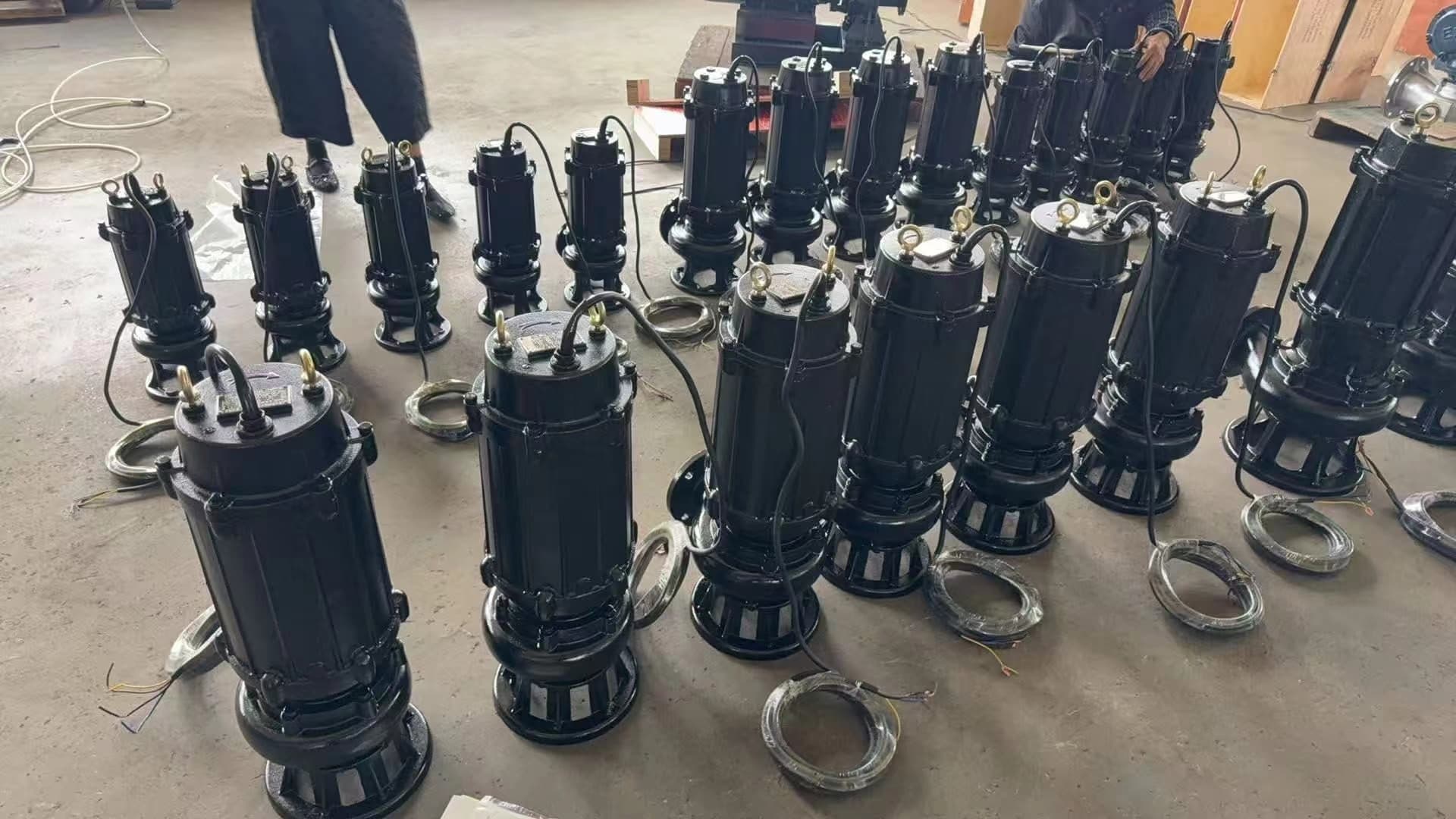 Submersible Sewage Pumps
200QW250-18-22 Sewage Pump: Factory Test Results
200QW250-18-22 submersible sewage pump: 250 m³/h at 18 m, 22 kW, DN200. Factory test results: 19.19 m at 250 m³/h and 68.6% pump efficiency.
Submersible Sewage Pumps200QW300-15-22 Submersible Sewage Pump, 300 m³/h 15 m
200QW300-15-22 submersible sewage pump: 300 m³/h at 15 m, 22 kW 4-pole, DN200 outlet. Installation dimensions, flange data and drawing download.
Submersible Sewage Pumps150QW180-15-15 Sewage Pump: Curve and Dimensions
150QW180-15-15 submersible sewage pump: 180 m³/h at 15 m, 15 kW 4-pole, 1450 r/min, DN150. Performance curve explained and installation dimensions.
Need a pump for your application?
Our engineers respond to technical inquiries within 24 hours.
Get a Quote