
Choosing the Right Impeller for a Sewage Pump
How to Choose a Single- or Double-Channel Sewage Pump Impeller
Choosing a submersible sewage pump is not only about selecting the correct flow and head.
The wastewater itself should determine the hydraulic design.
A pump handling municipal sewage may see fibers, paper, plastic fragments and suspended solids. An industrial wastewater pump may face a completely different mixture of solids and liquids.
For this reason, the impeller should be selected together with the pump duty rather than treated as an isolated component.
Start With the Wastewater
The first question is simple:
What is actually in the wastewater?
If the liquid contains a large amount of long, flexible material, a single-channel impeller may be advantageous because its large passage gives these materials a relatively open route through the hydraulic section.
For example, applications involving textile fibers, hair, plastic bags or similar soft materials may require particular attention to passage geometry.
If the wastewater contains a mixture of solids and fibers and the pump will operate continuously, a double-channel impeller may provide a more balanced solution.
Single-Channel: Maximum Passage Priority
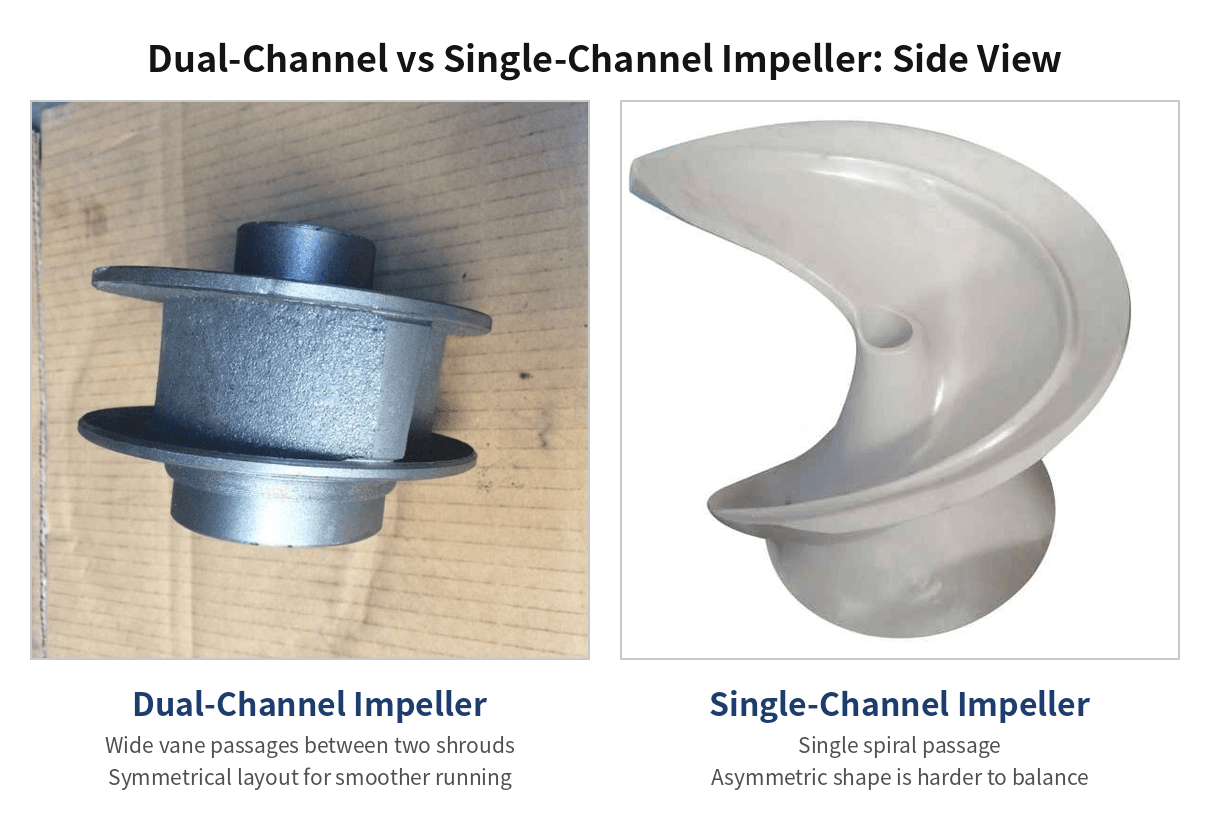
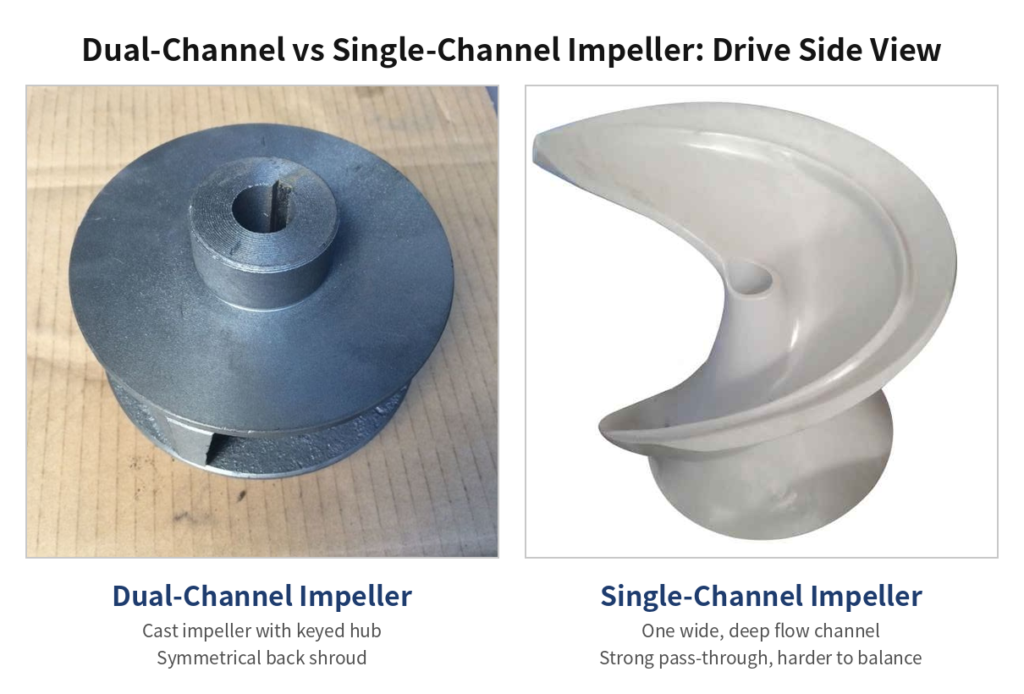
The single-channel impeller has one broad curved passage.
Its major advantage is its open hydraulic path. The supplied technical material identifies single-channel impellers as particularly suitable for wastewater containing large amounts of plastic bags, sanitary products, hair and long fibers.
This configuration can be useful in:
septic tanks, hospitals, hotels, residential sewage and wastewater containing long fibers.
However, the same technical comparison notes that the single-channel design can have lower hydraulic efficiency and less favorable rotational balance than a symmetrical double-channel design.
Double-Channel: A More Balanced Solution
The double-channel impeller has two symmetrical hydraulic passages.
This geometry provides a better balance of the rotating assembly when properly designed and manufactured.
The supplied technical data describes the double-channel impeller as having:
- Higher hydraulic efficiency
- Better running stability
- More uniform wear
- Good performance for mixed solids and fiber wastewater
The document also identifies municipal sewage treatment plants, construction sites and industrial wastewater as typical applications.
That makes the double-channel configuration particularly interesting for continuous-duty wastewater pumping.
Why Balance Matters
A sewage pump may operate thousands of hours during its service life.
An impeller that is properly designed and dynamically balanced can help reduce unwanted vibration and mechanical stress.
The importance of dynamic balancing is reflected in commercial non-clogging pump designs, where impellers are dynamically balanced to support smooth operation.
This is particularly important for larger pumps and continuous-duty installations.
Cast Iron vs. 304 Stainless Steel
For general sewage applications, cast iron is commonly used for the pump body and impeller because it provides a good combination of mechanical strength, wear resistance and manufacturing cost.
304 stainless steel is suitable for applications where increased corrosion resistance is required.
For more aggressive chemical environments, the material selection may move to 316L stainless steel or specialized alloys, depending on the liquid chemistry.
Commercial pump ranges demonstrate that channel impellers can be manufactured from cast iron and stainless steel, depending on the application.
A Practical Selection Guide
| Wastewater condition | Impeller to consider |
|---|---|
| Long fibers and soft materials | Single-channel |
| Mixed solids and fibers | Double-channel |
| Continuous municipal sewage duty | Double-channel |
| Industrial wastewater | Double-channel or application-specific design |
| Very high solids or abrasive material | Consider vortex, cutter or slurry-type hydraulics |
| Corrosive wastewater | 304/316L or other suitable material |
The technical material also notes that when solids concentration is high or particles are hard and abrasive, a conventional channel impeller may not be the best solution; vortex, cutter or slurry-pump designs may need to be considered instead.
Custom Sewage Pump Configurations
For export projects, the hydraulic design can also be combined with customer-specific motor requirements.
For example, a submersible sewage pump can be configured for 415 V, 50 Hz three-phase power where this matches the local electrical supply and the selected motor is designed for that voltage and frequency.
Other project-specific requirements may include:
- Flow rate
- Pump head
- Discharge diameter
- Motor power
- Impeller type
- Cast iron or stainless-steel construction
- Mechanical seal arrangement
- Automatic coupling
- Control panel
- Cable length
- Installation method
Conclusion
The best sewage pump impeller is determined by the actual application.
Single-channel impellers are particularly useful when the wastewater contains difficult long fibers and soft materials where passage capacity is the main concern.
Double-channel impellers provide a more symmetrical hydraulic structure and are commonly selected for municipal and industrial sewage systems where efficiency, balanced operation and long-term stability are important.
For many general WQ/QW sewage pump applications in China, the double-channel impeller is a mainstream configuration, while single-channel designs remain an important choice for specific high-fiber wastewater duties.
The goal is not simply to choose the impeller with the largest passage. The goal is to match impeller geometry, solids characteristics, flow, head, material and operating duty to the actual pumping system.
Need a pump for your application?
Our engineers respond to technical inquiries within 24 hours.
Get a Quote